Special Entry: How far do you agree that women were misrepresented in nationalist narratives?
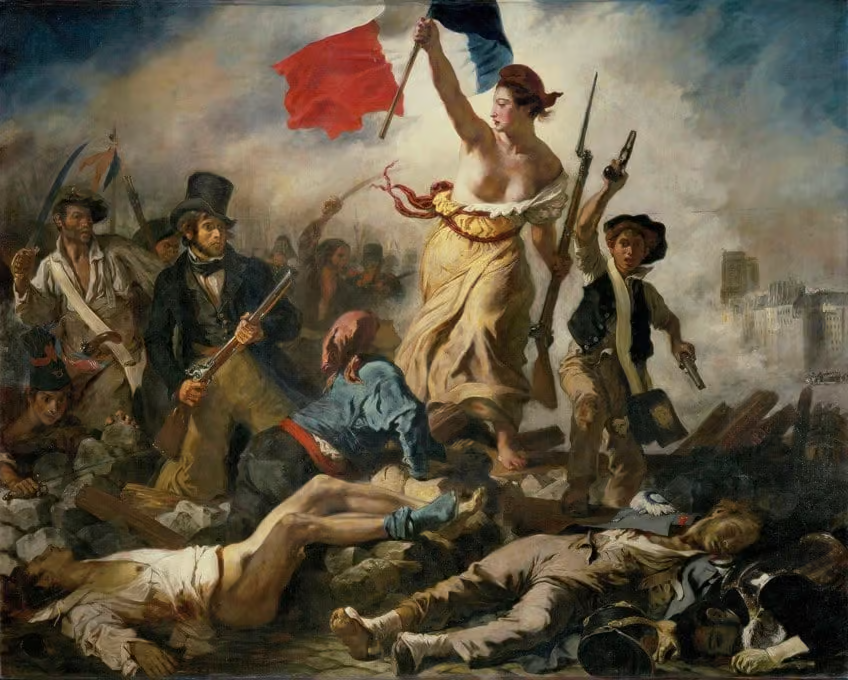
Liberty Leading the People (1830) by Eugène Delacroix
In history, stories from nationalist movements often wrongly ignore or misrepresent women's roles. Women have been part of these movements as leaders, fighters, and thinkers. Yet their contributions often take a back seat, depicted in ways that fit old gender roles. Here, I will look at this misrepresentation by focusing on symbolic marginalisation, the ignorance of active roles, and the spread of gender disinformation.
In many nationalist narratives, women are depicted as symbols of the nation’s purity and culture, often shown as mothers or guardians of tradition rather than as active participants in nation-building. This gives women a passive role, focusing on their duty to uphold cultural values rather than recognizing their contributions to political struggles. Nationalism often assigns gender roles, with men representing political and military strength and women confined to preserving tradition. This limits women’s roles to symbolic figures rather than decision-makers. This pattern can be seen in different nationalist movements.
During the Nasser era in Egypt, feminist activists were instrumental in the independence movement, organising protests, leading demonstrations, and demanding constitutional reforms that challenged British colonial rule and advocated for women’s rights. Yet after independence, women were largely pushed out of political life. The government dissolved feminist organizations like the Egyptian Feminist Union (EFU) and placed women’s activism under state control. Although women were given some legal rights, granted suffrage in 1956, they were largely excluded from political leadership, and personal status laws remained restrictive, reinforcing male authority in marriage, divorce, and family matters. Their involvement was acknowledged aloud but not in positions of power, showing how their contributions were valued only when convenient for the nationalist cause.
Similarly, in post-colonial African nationalist movements, women who had actively participated in liberation struggles were later sidelined. In Algeria, female fighters for the National Liberation Front (FLN) in the independence war were celebrated as martyrs but were not given roles in governance, despite proving their capabilities as intelligence agents, combatants, and organisers. Instead, post-independence policies reinforced traditional gender roles, encouraging women to return to domestic roles and limiting their legal rights. Their wartime efforts were rarely reflected in official histories, and their potential to lead was ignored.
In Ireland’s nationalist movement, women like Countess Constance Markievicz played significant roles by participating in armed resistance, organising labour strikes, and advocating for workers’ and women’s rights. Markievicz fought in the 1916 Easter Rising and later became the first woman elected to the British Parliament in 1918 and the first woman to hold a cabinet position in Ireland as Minister for Labour of the Irish parliament in 1919. Yet despite her revolutionary political accomplishments, she was portrayed and remembered more for her sacrifice and hardships, like many other women of that time. After independence, even when women had been leaders in the struggle, nationalist narratives reduced them to symbols of suffering rather than recognizing their strategic contributions.
Despite their active involvement, women's contributions to nationalist movements are often deliberately minimized or erased in history, as nationalist movements seek to restore traditional gender roles once their immediate need for women’s participation has passed. This serves to reinforce male dominance in politics and society and ensure power remains concentrated among men. In the former Yugoslavia, feminist scholars have pointed out how women’s experiences during conflicts were often ignored or misrepresented. Women served as fighters, medics, and resistance members during the wars in the Balkans, but historical accounts often emphasized men’s roles while reducing women’s contributions to passive suffering or support roles. These selective stories have shaped national identity in ways that ignore female agency.
Similarly, in India, women such as Sarojini Naidu and Aruna Asaf Ali were key figures in the fight against British rule, organising protests and leading resistance efforts. Yet post-independence, women struggled to gain political influence. Although some secured positions, mainstream nationalist narratives focused more on male leaders like Gandhi and Nehru, downplaying the role of women in the independence movement. The exclusion of women from major political leadership reinforced the idea that nation-building was primarily a male endeavour.
This is also visible in Britain during the Second World War. British women contributed significantly to the war effort, taking on roles in factories, agriculture, and civil defence. Yet, after the war, their contributions were quickly dismissed, and women were encouraged to return to traditional domestic roles. Despite their wartime service, their demands for political rights – such as equal employment opportunities and the right to vote – were largely ignored, displaying how female involvement was seen as temporary, not transformative. By systematically erasing women’s roles in nationalist struggles, historical narratives reinforce the belief that national liberation was achieved solely by men. This distorts history and limits women’s political and social opportunities in the present, as their past contributions remain unrecognized.
Today, nationalist movements still misrepresent women through gendered disinformation campaigns, deliberately spreading false or misleading narratives to damage women’s credibility in public life. Nationalist agendas often use such tactics to question women’s legitimacy, competence, or moral character, reinforcing traditional gender hierarchies and discouraging female political participation. Studies show that women politicians are disproportionately targeted with misinformation compared to their male counterparts, making it harder for them to gain public trust and maintain political influence.
This can be seen in Spain, where the far-right party Vox has weaponized gender issues during elections to attack feminism and promote traditional gender roles. For example, Vox has falsely claimed that gender violence laws unfairly discriminate against men and that feminism is a threat to national unity. By spreading such narratives, nationalist forces delegitimize women’s rights movements, portraying them as radical or unpatriotic, which strengthens old patriarchal structures and justifies regressive policies.
In Ukraine, nationalist disinformation campaigns have targeted female politicians and activists as lacking national loyalty, their actions framed as aligning with Western interests. Former prime minister Yulia Tymoshenko, for instance, faced allegations of having undisclosed ties to Russian President Vladimir Putin, despite her advocacy for Ukraine's integration into the EU. These tactics serve to discredit female politicians by questioning their patriotism and authenticity.
A similar tactic has been used in Poland, where conservative media outlets depict feminist activists as adversaries of traditional family structures and societal norms. A study analysing right-wing press narratives revealed that feminists were portrayed as attacking ‘the family and order,’ with protests framed as national threats. This aligns with the broader populist right-wing agenda, which seeks to preserve conventional values by discrediting progressive movements. State-affiliated media and nationalist politicians have spread rumours that feminist activists are funded by foreign interests, portraying them as enemies of the Polish state, distracting from their core objectives and hampering progress toward women's rights and broader democratic principles. Activists encounter obstacles in efforts to promote gender equality and challenge restrictive laws. This disinformation campaign frames feminism as attacking Polish Catholic values, discouraging wider public support for gender equality initiatives.
Gender disinformation goes beyond individual attacks – it creates a hostile environment that discourages other women from entering politics. When women see how female politicians are vilified, harassed, or delegitimized, they are less likely to run for office or engage in political activism. This maintains the gender imbalance in national politics and perpetuates the outdated view of women as passive figures rather than active agents of political change.
Beyond academic research, feminist perspectives on nationalism advocate for revisiting narratives to include women’s roles more prominently, critiquing how nationalist movements have historically overlooked or sidelined women and calling for a more inclusive understanding of national identity. One approach to this is political gender quotas, implemented in countries such as Rwanda, Argentina, and Sweden to ensure female government representation. These quotas not only increase women’s political participation but also inclusively shift national views of leadership.
Another crucial initiative is reforming history education, where activists and educators push for revisions to textbooks and curricula to ensure women’s roles in nationalist struggles are properly acknowledged. In Tunisia and South Africa, education reforms seek to integrate women’s contributions into national histories to counter decades of omission. By including women as active agents in independence movements, we challenge the traditional male-centred view of national liberation.
Correcting the historical exclusion of women does justice to the past and completes national histories, shaping future national identities in a more equitable way and ensuring that national pride is built on inclusivity rather than erasure. Women have often been consistently misrepresented in narratives about national pride, with their real participation downplayed, ignored, and even erased to maintain traditional gender roles—even now. Yet women have been instrumental in shaping nationalist movements. Recognizing and correcting these misinterpretations is vital for establishing a more accurate and inclusive historical record. By addressing the myths long defining history, researchers and activists strive to highlight the significant influence of women in forming national identities.
This piece was written by Lucrezia Burke, the winner of The Webster Review 2025 EDI Essay Competition.
Bibliography
‘Women as Symbols in Nationalism’, Identity Hunters, 10 February 2021, accessed March 31 2025, <https://identityhunters.org/2021/02/10/women-as-symbols-in-nationalism/?utm>
‘Egypt: Divorced from Justice II’, Human Rights Watch, 30 November 2004, accessed March 31 2025, <https://www.hrw.org/reports/2004/egypt1204/2.htm >
Ayverdi-Natali, H (2021), ‘The Battle of Algiers’ in Film vs. Reality; The Woman’s Role and
Erasure in the Algerian Revolution’, Cove, 11 November, accessed March 31 2025, <https://editions.covecollective.org/content/battle-algiers-film-vs-reality-womans-role-anderasure-algerian-revolution?utm>
Clarke, M (2021), ‘Constance Markievicz: The making of a rebel Countess’, The National Archives, 2 April, accessed March 31 2025, <https://blog.nationalarchives.gov.uk/constancemarkievicz-the-making-of-a-rebel-countess/?utm>
‘Women’s experiences during the Irish Civil War’, The Irish Revolution Project, 19 October 2022, accessed March 31 2025, <https://www.ucc.ie/en/theirishrevolution/featurearticles/womens-experiences-during-the-irish-civil-war.html?utm>
Batinic, J (2001), ‘Feminism, Nationalism, and War: The ‘Yugoslav Case’ in Feminist Texts’,
Journal of International Women’s Studies, 3(1), Article 1,
<https://vc.bridgew.edu/cgi/viewcontent.cgi?article=1593&context=jiws>
‘Sarojini Naidu: Nightingale of India, Contributions, Advocacy for Women’s Rights’, Vajiram & Ravi, 25 January 2025, accessed March 31 2025, <https://vajiramandravi.com/upscexam/sarojini-naidu/?utm>
Sumithira, A (2024), ‘Political Representation of Women in Post-Independence India’,
Contemporary Studies in Social Sciences, 2(2), 151-168,
<https://www.researchgate.net/publication/387503325_Political_Representation_of_Women_i n_Post-Independence_India>
O ice of the Prime Minister (2015), ‘A look at the role of women in the Second World War in the lead up to the 70th anniversary of Victory in Europe (VE) Day’, Gov.uk, accessed March 31 2025, <https://www.gov.uk/government/news/the-women-of-the-second-world-war?utm>
‘Post World War II: 1946-1970’, Striking Women, accessed March 31 2025,
<https://www.striking-women.org/module/women-and-work/post-world-war-ii-19461970?utm>
Di Meco, L (2020), ‘Why disinformation targeting women undermines democratic institutions’, Power3.0, 21 May, accessed 31 March 2025,
<https://www.power3point0.org/2020/05/01/why-disinformation-targeting-womenundermines-democratic-institutions/>
Zabala, S (2019), ‘Spain’s far right hates not only immigrants, but also women’, Aljazeera, 20
January 2019, accessed March 31 2025,
<https://www.aljazeera.com/opinions/2019/1/20/spains-far-right-hates-not-only-immigrantsbut-also-women?utm>
Żuk, P, Pacześniak, A (2023), ‘“They attack the family and order”: Right-wing media about feminists and the political consequences of the women's strike in Poland’, Frontiers in
Sociology, Jan 11, accessed March 31 2025,
<https://pmc.ncbi.nlm.nih.gov/articles/PMC9874944/?utm>
‘“The Breath of the Government on My Back” Attacks on Women’s Rights in Poland’, Human
Rights Watch, February 6 2019, accessed 31 March 2025,
<https://www.hrw.org/report/2019/02/06/breath-government-my-back/attacks-womens-rightspoland?utm>
Rosińska, K (2021), ‘Disinformation in Poland: Thematic classification based on content analysis of fake news from 2019’, Cyberpsychology: Journal of Psychosocial Research on Cyberspace, 15(4), Article 5. <https://doi.org/10.5817/CP2021-4-5>
Dutta, R (2023), ‘Rwanda’s 30 percent gender quota led to the world's largest share of women in government’, Pathfinders, June 6, accessed March 31 2025,
<https://www.sdg16.plus/policies/rwandas-30-percent-gender-quota-led-to-the-worldslargest-share-of-women-in-government/?utm>
Mdeleni, L, Mandyoli, L, Frantz, J (2021), ‘Tenacity of Gender Inequality in South Africa: A
Higher Education Perspective’, Policy and Practice: A Development Education Review, <https://www.developmenteducationreview.com/sites/default/files/articlepdfs/Lwando%20Mdleleni%20et%20al.%20Viewpoint%20Issue%2033%20.pdf>


Comments