Special Entry: How far do you agree that women were misrepresented in nationalist narratives?
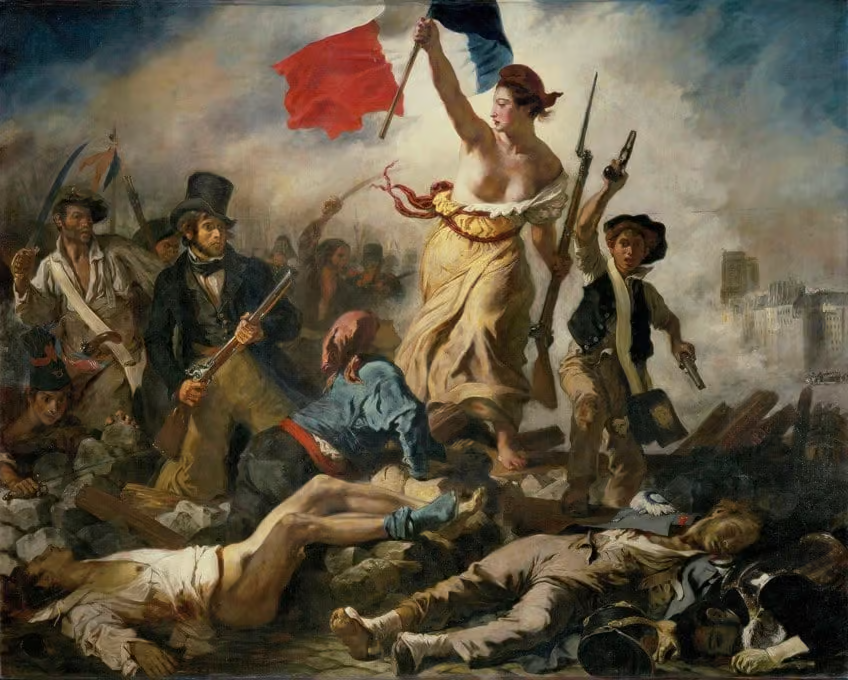
Liberty Leading the People (1830) by Eugène Delacroix
When looking at contemporary narratives from the period of the French Revolution (1789-99), there is a striking contradiction. Women were systematically transformed into and represented as ideological symbols, through pamphlets, cartoons, paintings and statues. This symbolic ‘elevation’ of women allowed revolutionaries to use these symbols as devices to project and further their ideological and political beliefs. Meanwhile, the political exclusion of women during this period was widespread and common, leading to their misrepresentation and exclusion from revolutionary narratives. This essay focuses on how the representation of women as symbols – whether as embodiments of virtue, liberty or corruption - facilitated the exclusion of real women from political and public life, erasing their contributions and systematically misrepresenting them. Paradoxically, women’s symbolic presence in revolutionary iconography can be seen as inversely proportional to their real political power as women were so helpful to revolutionaries as ideological devices precisely because they lacked political agency and power, and were therefore blank canvases on which it was easy to project beliefs and ideals.
Thus, contemporary revolutionary and nationalist discourse relied on gendered, and specifically female, symbolism to promulgate the Republic’s ideology and politics. By analysing the ways in which women were represented—or misrepresented—in contemporary sources, the contradiction at the heart of French revolutionary narratives, where women were at once represented as central to the imagery of the Revolution and yet representation of the political contributions of real women was almost entirely absent, can be revealed.
Marie Antoinette
By the time Marie Antoinette was executed in October 1793, she had been made into a figure of such intense infamy that her guillotining was accompanied by the cheers of thousands of bloodthirsty Parisians. Throughout her reign as France’s queen, she had been vilified through pamphlets, libelles and cartoons and by the time the revolutionaries came to power in 1789 she was the subject of such intense hatred that there was no doubt she was going to be one of the first victims of the new government’s reign of Terror [1]. The interest and complexity of her execution emerges when examining how Marie Antoinette was killed not only because of her role as a monarch in a toppled regime, but as a symbol for all the crimes, political and ideological, of that regime. Her use for the revolutionaries in 1793 was as an object on which the anger of society could be directed: an embodiment of the faults of the Ancien Regime, and its’ surrogate victim [2]. In order to fully delegitimise the old regime and consolidate their power, the revolutionaries needed a tangible figure to assume all the grievances of the French people; a figure who could conveniently be put to death, appeasing their collective desire for revenge. Girard explains this phenomenon:
“A single victim can be substituted for all the potential victims… All the rancours scattered at random among the divergent individuals, all the differing antagonisms, now converge on an isolated and unique figure, the surrogate victim.”
It is easy to see why Marie Antoinette was an obvious figure to be this victim. The extensive history of public slander surrounding her actions and person had already transformed her into a symbolic vessel for all perceived crimes of the Ancien Regime against the people [3]. She was politically malleable, and was able to be shaped in any way the revolutionaries desired, due to her position as a Queen, and a woman. Unlike Louis XVI, whose political actions during his reign had been more or less explicitly documented through speeches, letters and policies, Marie Antoinette’s political exclusion – her inability to publicly express herself or participate in the political sphere during her reign – made her a ‘blank canvas’ for rumours and conspiracy theories. This echoes an analysis by Natalie Davis on the role of women in early modern Europe, where she found their absence of direct political voice often led to representation in distorted ways [4].
When looking at revolutionary depictions of Marie Antoinette, it is clear she symbolises something beyond the Ancien Regime. She was also useful to revolutionaries as a depiction of the ‘anti-woman’; a figure who represented everything French Republican womanhood should not be. She was depicted as a controlling wife, a promiscuous adulterer, a mother accused of raping her own son. In this way, you can see how Marie Antoinette was a figure that served a dual purpose: both the embodiment of the Ancien Regime, and the antithesis of an ideal Republican woman. In both cases, this vilification was significantly facilitated by her gender. Her political exclusion throughout her reign is precisely what made her the perfect device for the revolutionaries to project on, and her gender allowed her to become a device with which revolutionaries could distribute their ideals of what a woman should be, through depicting Marie Antoinette as the antithesis of these. Through her trial and execution, the Republic managed to satisfy the people’s desire for retribution, provide a graphic and tangible punishment for the immaterial ‘crimes’ of the monarchy, and solidify its’ vision of a new France – one where women like Marie Antoinette could have no place.
The embodiment of Liberty
So, if Marie Antoinette was the symbol of the Ancien Regime, what was chosen as the symbol of the new Republic? Choosing a figure to represent the new nation proved extremely divisive. Many republicans protested altogether against the idea of a single representation of the new France [5]. As Thomas Paine argued, “The old idea was that man must be governed by effigy and show, and that a superstitious reverence was necessary to establish authority. . . . The putting of any individual as a figure for a nation is improper." The use of icons to promote a regime’s ideals recalled memories of Catholicism, monarchy, and the old France. "The instant a people chooses representatives," Rousseau states, "it is no longer free; it no longer exists.”. Despite this, beginning even in the 1790s, in paintings, pamphlets and statues, a mysterious figure emerged that eventually came to symbolise the new Republic and all its’ values: a young woman, sometimes depicted as the goddess Liberty, later called ‘Marianne’.
This woman emerged as the allegorical representative of the main revolutionary ideals of liberty, equality and virtue. She is often depicted wearing a tricolour sash and a Phrygian cap, clearly marking her as a symbol of the revolution. Through her antique clothes, she not only demonstrates a return to the idealised Republics of Ancient Greece or Rome, but also appears as the goddess Athena, and therefore a symbol of law and equality. She is always figured as young, innocent, and pure; the Rousseauian ideal of womanly virtue. Her virginity comes to represent the revolutionary ideal of putting the collective will over personal desires, clearly contrasting against the sinful body of Marie Antoinette. With this comes another use: through Liberty, revolutionaries could demonstrate the merits of their new government, while contrasting it with the Ancien Regime.
There is, however, something deeply paradoxical about representing the body politic as a female in a revolution that granted political rights to men but not to women. Yet, as Marina Warner states, "Liberty is not represented as a woman . . . because women were or are free". Lynn Hunt instead observes "the proliferation of the female allegory was made possible, by the exclusion of women from public affairs. Women could be representative of abstract qualities and collective dreams because women were not about to vote or govern" [6]. Liberty was distinct from the former figureheads of old regimes (such as Louis), because she was a woman. She was able to embody the revolutionary government as she could not be confused with any real political figures, due to women’s lack of political autonomy in this period, and therefore could not cause division or tension. [7]. She could also personify the abstract revolutionary principles of the Enlightenment philosophes.
Liberty was a deeply gendered figure, much like Marie Antoinette, although their respective roles differed greatly. Essentially, both women were devices with which the revolutionaries could promulgate their ideals and political aims. Their ultimate utility as symbols lay in their lack of political autonomy; Liberty could be reshaped into an abstract, unthreatening metaphor for the Republic in the same way Marie Antoinette could be reshaped into a metaphor for the crimes of the Ancien Regime. Through narratives in cartoons, paintings and pamphlets, the revolutionaries used these two figures to demonstrate their political ideals for the new Republic.
Real revolutionary women
There has been much discussion about female symbols and their presence in revolutionary narratives, but what of real revolutionary women and their political contributions? Debates about women and their rights started from the very beginning of the revolution, with elections in April 1789 opening a period of unprecedented institutional and ideological change. Along with the debates over popular sovereignty and Rights of the Man came the obvious question: could women, in this revolutionary era, be part of political life? [8]. The constitutions of 1791 and 1793 presumably resolved this debate. Women were denied the right of active citizenship (1791), and democratic citizenship (1793).
However, throughout the period of 1789-99, it is abundantly clear women did in fact partake in the political sphere: through their membership of political clubs and societies, their involvement with petitions, and during journées where women repeatedly applied insurrectionary force to consequent regimes. These actions of women, in the absence of their political and legal citizenship, can be defined as acts of militant citizenship [8], and are clear examples of their political involvement in this period. The revolutionary governments’ responses to the actions of women were complex. As Levy says,
‘They veered between co-opting, directing, and exploiting women's claim to a political identity; they ridiculed it, symbolically recast it in order to defuse it, and repressed it.’
The strategies employed to misrepresent women's contributions to the revolution were multifaceted and extensive. Notably, one intriguing pattern emerges: the female symbols constructed by revolutionaries were used to diminish and undermine the political actions of real women.
On 5 October 1789, 7,000 Parisian women rose in insurrection against the National Assembly and the King, marching to Versailles armed with pikes, clubs, knives, swords, muskets, and dragging cannon [9]. The result of these events was the forcible move of the King and his family to Paris, an event that holds significant importance in the timeline of events leading to the fall of the monarchy. There is one particular moment which proves the October Days were a clear demonstration of women’s militant citizenship: the invasion of the National Assembly on the evening of the fifth.
The women rushed into the hall of the legislature, interrupted debate, pressured and intimidated the deputies, and demanded they discuss the problems in Paris. One journalist reported “three thousand women” voted with the deputies on motions relating to legislation on the distribution of grains. These women ‘seized’ power from the deputies unable or unwilling to represent them, and therefore, “on this incomparable day, they exercised the functions of legislative and executive powers” [10]. One may doubt significance of this insurrection, but it is important to note that during this period uprisings and popular revolts were common and effective forms of change. They were legitimised “as the arm of the sovereign nation, the most authentic embodiment and expression of the general will” [8], and thus, the often sporadic and militant nature of women’s actions cannot be undermined as politically insignificant.
To understand how women’s actions in the October Days were viewed and represented in revolutionary narratives, one should look no further than Herault de Sechelles’, the President of the National Convention, speech to a group of women selected to represent the “heroines of the fifth and sixth of October 1789." Sechelles attributed the women’s courage - despite the weakness of their sex – to the miraculous interventions of “Liberty”. She had ignited "in the heart of several women this courage which caused the satellites of tyrants to flee or fall before them." Making use of the "delicate hands" of women, Liberty had caused the cannons to roll—these "mouths of fire" whose "thunder" forced the king to capitulate to the people. Following this, Seychelles told the assembled women to confine themselves to giving birth to "a people of heroes" and to nourish them with breast milk to develop their martial virtue [11].
This speech is an unbelievably clear example of how revolutionaries used these constructed female allegories to undermine the actions of real militant women. It plays into the greater idea used constantly in revolutionary narratives; that women cannot act as individuals, with genuine political reason, but only as abstract groups, inspired by vague and spontaneous emotion. In this case, Seychelles clearly attributes the reason for the women’s march as the mysterious involvement of Liberty, systematically reducing their actions to an abstract, symbolic gesture rather than recognizing them as individuals with intentional and conscious political motives.
The “war of the cockades” in 1793 is another example of how female symbols were extremely useful to the revolution, while real women were decidedly not. This period was a debate surrounding women’s right to wear the republican cockade. In the end, the club whose members where primarily involved, the Society of Revolutionary Republican Women, was abolished and women were forbidden from wearing the cockade and the liberty cap, which were both seen as signs of citizenship unsuited to women’s use. Overall, this “war” demonstrates two things: how women’s political participation was seen as inherently dangerous, and secondly, the divide between women’s representation in female figures like Liberty and their actual treatment. It highlights the inherent contradiction in revolutionary narratives with how the liberty cap became sexually as well as politically transgressive when it moved from the head of "Liberty," to the heads of actual militant women in the streets. It was dangerous for women to wear the emblem of political and revolutionary action; the government could not allow it. While women as inanimate statues and paintings were infinitely helpful to the revolutionary cause, real revolutionary women posed a significant threat to the order and stability so desired by the new Republic. Women had to be misrepresented, and revolutionaries achieved this, paradoxically, through the use of female allegories.
I believe this contradiction between the frequent representation of women as symbols and the misrepresentation of real women’s contributions is part of a greater trend when looking at French revolutionary nationalist narratives, as well as revolutionary and nationalist narratives as a whole. It demonstrates how women are often only useful in nationalist discourse as inanimate figures onto which ideals, crimes, events and beliefs can be projected. They can be mothers of the nation, corrupting influences on politicians and kings, or wives who can bear the next generation, depending on the political needs of the men in charge. But they are never represented as actual, political agents. The contradiction observed in French revolutionary narratives, therefore, is not an anomaly but part of a deliberate and recurring political strategy engaged by many governments throughout history as a calculated means of consolidating their authority, placing female figures as central to their establishment and continuation of power, while systematically silencing women’s voices and misrepresenting their contributions.
This piece was written by Camille Spender, the runner-up of The Webster Review 2025 EDI Essay Competition.
Bibliography
R. Girard, “Violence and the Sacred,” John Hopkins University Press, 1977.
O. Fuson, “Marie Antoinette’s Sacrifice and the Fragmentation of French Femininity,” Aisthesis: The Interdisciplinary Honors Journal, 2018.
L. Hunt, The Many Bodies of Marie Anotinette: Political Pornography and the Problem of the Feminine in the French Revolution, New York: Routledge, 1998.
N. Z. Davis, “Women's History in Transition: The European Case,” Feminist Studies 3, pp. 83-103, 1976.
R. Paulson, “Representations of Revolution (1789-1820),” Yale University Press, 1983.
Hunt, “Political Psychology,” French Caricature, p. 39.
J. Landes, “Representing the Body Politics: The Paradox of Gender in the Graphic Politics of the French Revolution,” Rebel Daughters, 1992.
D. Levy, “Women and Militant Citizenship in Revolutionary Paris,” Rebel Daughters, 1992.
“Reimpression de l'Ancien Moniteur 2,” 1789.
J. Faydel, Procedure criminelle, instruite au Chatelet, sur la Denonciation des fairs arrives a Versailles dans la journee du 6 october 1789, 1789.
J. David, “Reimpression de l'Ancien Moniteur,” 1793.
Rousseau, The Social Contract.
Warner, Monuments and Maidens.


Comments